NEWS2 Scoring Criteria & ICU Admission Directives<
On-Call Note: NEWS2 Scoring Criteria and ICU Escalation Directives
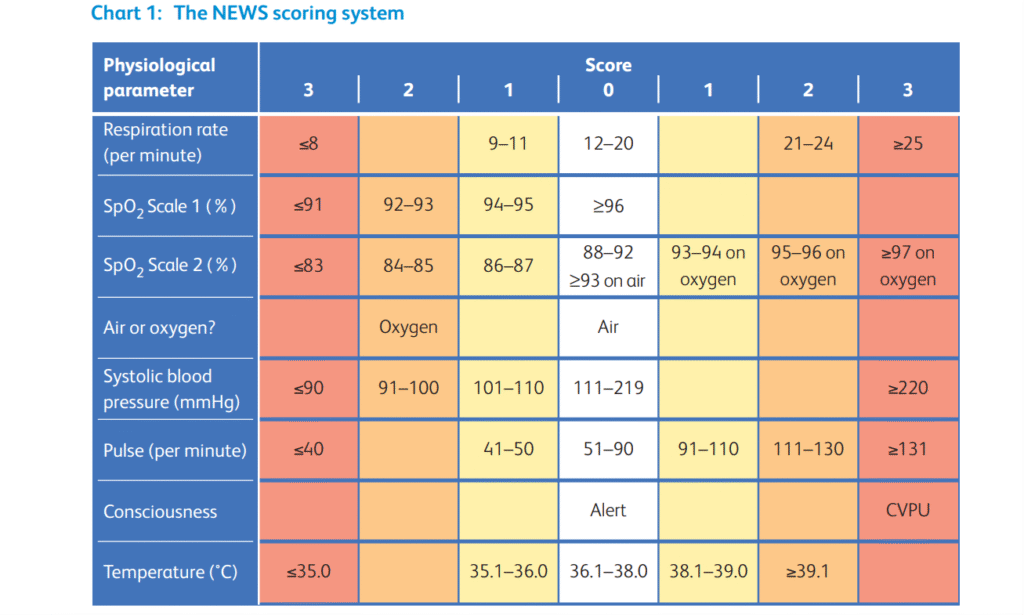
Reproduced from: Royal College of Physicians. National Early Warning Score (NEWS) 2: Standardising the assessment of acute-illness severity in the NHS. London: RCP; 2017.
Clinical Overview
The clinical purpose of NEWS2
The National Early Warning Score 2 (NEWS2) is a standardized bedside scoring system designed to detect acute physiological deterioration in adult inpatients. It was developed and endorsed by the Royal College of Physicians to support earlier recognition of clinical decline, trigger timely escalation, and guide the on-call clinician toward appropriate senior review, high-dependency monitoring, or ICU-level care when needed.
Practical on-call reading: NEWS2 is not just a number to document in the chart. It is a shared language between nursing staff, ward doctors, on-call clinicians, rapid response teams, and critical care. Its real value is that it prevents deterioration from being scattered across separate observations: a faster respiratory rate, lower blood pressure, rising pulse, new confusion, or new oxygen requirement. When these signals are aggregated into NEWS2, clinical concern becomes an actionable warning.
Practical on-call rule: Do not treat NEWS2 as a blind decision machine. A high score mandates escalation, but a low score does not cancel clinical concern if the patient is deteriorating. The score helps you see risk, but it does not replace history, examination, trajectory, response to treatment, and bedside judgement.
When NEWS2 is especially useful
- On the ward: When the patient is “not quite right” and the clinical picture is still incomplete.
- During night shifts: When a numerical language is needed to justify escalation, attendance, or senior review.
- During handover: Because the trend in NEWS2 over time is often more important than a single isolated value.
- In suspected sepsis, respiratory failure, or shock: NEWS2 can capture physiological drift before full collapse is obvious.
- When considering critical care: NEWS2 places the patient into a structured risk band, but it must be integrated with clinical assessment, blood gases, laboratory results, comorbidities, and disease trajectory.
Investigations and Monitoring
Physiological parameter triage: NEWS2 calculator
Mobile navigation note: Swipe the table horizontally to view all score metrics. Calculate the score from the most recent reliable worst value, then always ask: is this score stable, or is it rising?
| Physiological Parameter | Score (3) | Score (2) | Score (1) | Normal (0) | Score (1) | Score (2) | Score (3) |
|---|---|---|---|---|---|---|---|
| Respiration Rate | ≤ 8 | 9 - 11 | 12 - 20 | 21 - 24 | ≥ 25 | ||
| Oxygen Saturation (Scale 1) | ≤ 91 | 92 - 93 | 94 - 95 | ≥ 96 | |||
| Air or Oxygen? | Oxygen | Air | |||||
| Systolic BP | ≤ 90 | 91 - 100 | 101 - 110 | 111 - 219 | ≥ 220 | ||
| Pulse | ≤ 40 | 41 - 50 | 51 - 90 | 91 - 110 | 111 - 130 | ≥ 131 | |
| Consciousness | New confusion or CVPU | Alert | |||||
| Temperature (°C) | ≤ 35.0 | 35.1 - 36.0 | 36.1 - 38.0 | 38.1 - 39.0 | ≥ 39.1 |
Important scoring notes for the on-call clinician
- Supplemental oxygen: Any oxygen being delivered to the patient adds 2 points in NEWS2, even if the saturation looks acceptable.
- Consciousness: New confusion or response only to Voice, Pain, or Unresponsive is a serious consciousness abnormality and should not be dismissed as simple tiredness.
- Single parameter score of 3: Even if the aggregate score is not high, a red score in one physiological parameter should raise concern and trigger urgent clinical review.
- Scale 1 and Scale 2: The table above shows Scale 1. In patients with COPD or risk of hypercapnic respiratory failure, Scale 2 should only be used if clinically documented and locally agreed. Do not reduce oxygen or accept low saturations without a clear reason and a blood-gas plan.
- Trend matters more than a single number: NEWS2 4 that is rising quickly may be more dangerous than NEWS2 5 that is stable in a chronic patient. Follow the trajectory, not the number alone.
Escalation Algorithm
Clinical response by aggregate score
NEWS2 points are systematically aggregated to define the urgency of clinical response. Reference protocols recommend the following escalation logic:
- Score 0-4: Low-risk profile. Standard ward observation and routine nursing monitoring, with vital-sign reassessment typically every 4 to 6 hours according to local policy. Exception: any single parameter scoring 3 explicitly requires urgent registered clinician review.
- Score 5-6: Medium-risk profile. This triggers a formal response alert. It requires direct hands-on clinical evaluation by a qualified clinician, usually within a maximum 60-minute window. The probability of clinical deterioration is significant.
- Score ≥ 7: High-risk emergency. This activates emergency escalation. It requires immediate review by a team with critical-care competencies, such as a Critical Care Outreach Team, and often consideration of transfer to HDU or ICU-level care.
Practical interpretation at each score level
- NEWS2 0: This does not mean the patient is guaranteed safe. It means current physiology is stable. Continue monitoring according to the illness context.
- NEWS2 1-4: Ask: is there a single parameter scoring 3? Is the score rising? Has the patient changed clinically? If yes, do not wait for the aggregate score to reach 5.
- NEWS2 5-6: This is not a comfortable “moderate” score. It is an urgent review threshold. Find the cause, start initial treatment, and decide whether the patient needs escalation, monitoring, blood gases, imaging, fluids, antibiotics, or critical-care review.
- NEWS2 ≥ 7: Treat this as a near-collapse warning. Go to the patient, assess ABCDE, call appropriate support, and do not simply document the number in the chart.
ABCDE algorithm for elevated NEWS2
- A - Airway: Is the airway patent? Is there stridor, vomiting, edema, bleeding, reduced consciousness, or aspiration risk?
- B - Breathing: Respiratory rate, SpO₂, oxygen requirement, work of breathing, lung sounds, blood gases, and risk of respiratory failure.
- C - Circulation: Blood pressure, pulse, peripheral perfusion, urine output, bleeding, shock signs, and need for fluids or vasopressors.
- D - Disability: Consciousness, new confusion, GCS, glucose, seizures, sedative medications, and neurological deterioration.
- E - Exposure: Temperature, rash, sepsis signs, pain, hidden bleeding, lines, drains, wounds, and the likely source of deterioration.
Rapid on-call summary: NEWS2 does not ask you to calculate and wait. It asks you to calculate and act. The score is the beginning of assessment, not the end.
Red Flags
When to call or involve critical care
ICU or HDU escalation does not depend on numbers alone. It depends on the aggregate NEWS2 score, the clinical trajectory, the response to initial treatment, and the patient’s physiological reserve.
- Absolute NEWS2 ≥ 7 threshold: A high aggregate score should be treated as an independent and powerful trigger for emergency clinical assessment and possible care in a monitored or critical-care environment.
- Rapid escalation trajectory: Even if the baseline score is low, a sudden increase of +2 points or more over a short time window suggests dynamic deterioration and may precede cardiopulmonary collapse.
- Refractory NEWS2 ≥ 5 state: A medium score that fails to respond to initial interventions such as oxygen titration or fluid bolus requires early escalation and reassessment of the care level.
Universal critical red flags beyond NEWS2
- Overt respiratory failure: Worsening arterial blood gases, exhaustion of accessory respiratory muscles, and need for invasive mechanical ventilation or non-invasive support such as NIV, BiPAP, or CPAP.
- Hemodynamic shock: Systemic shock that does not respond to large fluid boluses and requires intravenous vasopressor support.
- Acute neurological deterioration: Abrupt GCS drop to ≤ 8, sustained focal neurological signs, or refractory status epilepticus.
- Catastrophic metabolic derangement: Life-threatening metabolic acidosis, severe electrolyte disturbance such as hyperkalemia, or urgent need for emergency renal replacement therapy.
Additional red flags that should not wait for the score
- Rising oxygen requirement: A patient who was on room air and now needs escalating oxygen is deteriorating, even before NEWS2 reaches 7.
- New confusion: New delirium is a marker of systemic, respiratory, metabolic, or neurological failure until proven otherwise.
- Low blood pressure with poor perfusion: Cold peripheries, delayed capillary refill, oliguria, or raised lactate.
- Marked tachypnea: Respiratory rate is often the earliest sign of deterioration and should not be dismissed as anxiety.
- Failure of initial therapy: Persistent hypoxemia, hypotension, or confusion after first-line interventions should trigger early escalation.
Management Plan
What the on-call clinician should do when NEWS2 ≥ 5
- Go to the patient: Do not manage the score by telephone alone. Perform or directly supervise an ABCDE assessment.
- Confirm the observations: Repeat vital signs if they are inconsistent, but do not use repeated measurement as a way to delay escalation.
- Find the cause: Consider sepsis, bleeding, respiratory failure, myocardial infarction, pulmonary embolism, dehydration, arrhythmia, medication effect, surgical complication, or neurological deterioration.
- Start initial treatment: Appropriate oxygen, IV access, fluids when indicated, urgent blood tests, blood gas, lactate, glucose, ECG, cultures and antibiotics when sepsis is suspected, and imaging according to the clinical picture.
- Define the level of care: Ward with closer monitoring, HDU, or ICU.
- Escalate clearly: Use SBAR when calling for help: state the score, reason for concern, trajectory, what you have done, and what you need now.
When an ICU request becomes clinically convincing
- NEWS2 ≥ 7 with clinical deterioration, oxygen requirement, shock, or impaired consciousness.
- NEWS2 ≥ 5 that does not improve after initial treatment.
- Rapid increase in score over a few hours.
- Likely need for NIV, CPAP, BiPAP, intubation, invasive monitoring, vasopressors, or emergency renal replacement therapy.
- Serious underlying disease with low physiological reserve, such as severe COPD, advanced heart failure, immunosuppression, or major postoperative status.
- Strong clinical concern despite a score that is not yet high: the clinician sees a deterioration pattern the score has not fully captured yet.
Ready-to-use escalation call to critical care or rapid response
“This is Dr. (...) calling from ward (...). I am calling about a (...) year-old patient with a NEWS2 of (...) now, previously (...). The main concern is (...): breathing / blood pressure / consciousness / oxygen requirement. I have already done (...). The patient is not improving / is deteriorating rapidly. I need urgent critical-care or rapid-response assessment now, and I think the patient may need (...).”
Practical rescue point: Do not only say “NEWS2 is seven.” Say why it is seven, how it reached seven, what failed to improve, and what level of intervention you expect the patient may need.
Pearls and Pitfalls
Common on-call traps
- The low-score trap: A patient deteriorating rapidly may be dangerous before reaching NEWS2 ≥ 7.
- The oxygen-mask trap: Acceptable saturation on high-flow oxygen is not normal. The oxygen requirement itself is a danger signal.
- The ignored-respiratory-rate trap: Respiratory rate is one of the most sensitive markers of deterioration, but it is often estimated poorly or ignored.
- The confusion trap: New confusion is not “just sleepiness” until proven otherwise. Think hypoxemia, sepsis, shock, glucose disturbance, medication effect, or neurological pathology.
- The waiting-for-labs trap: Do not wait for lactate or blood gases if the patient is clinically collapsing.
- The score-instead-of-exam trap: NEWS2 does not examine the abdomen, listen to the lungs, see bleeding, or read your bedside concern. Examine the patient.
- The late-escalation trap: Calling critical care after everything has failed is worse than calling early when the collapse is beginning.
Practical on-call pearls
- If NEWS2 rises, search for the cause, not only the score.
- If NEWS2 is ≥ 5, ask: do I need review within an hour? Do I need blood gases? Do I need a higher-level team?
- If NEWS2 is ≥ 7, ask: does this patient need continuous monitoring, HDU, or ICU?
- If one parameter scores 3, do not be falsely reassured by a low aggregate score.
- If consciousness changes or oxygen requirement rises, escalate early.
- If treatment improves NEWS2, document the response and the next monitoring plan.
Rapid on-call summary
- NEWS2 0-4: low risk, but watch for a single red score or rapid upward trend.
- NEWS2 5-6: urgent review, assessment within 60 minutes, and a clear plan.
- NEWS2 ≥ 7: immediate response, often involving critical care or rapid response.
- NEWS2 does not replace clinical judgement.
- Respiratory failure, shock, GCS ≤ 8, refractory seizures, and dangerous hyperkalemia override the score.
- Do not treat NEWS2. Treat the patient whose physiology made NEWS2 rise.
References
Academic references
- NHS England. National Early Warning Score (NEWS). NHS Clinical Policy
- RCP London. The National Early Warning Score 2 (NEWS2). PMC6542226
- Royal College of Physicians. NEWS2: Clinical response to NEWS trigger thresholds. Chart 4.
- Royal College of Physicians. NEWS2: NEWS thresholds and triggers. Chart 2.
- MDCalc. National Early Warning Score (NEWS) 2. Diagnostic Tool
- BMJ Open. Evaluation of NEWS2 response thresholds. BMJ:e054027
- Intensive care unit admission criteria: a scoping review. PMC11366187
- Predictive value of the National Early Warning Score 2. PMC:10749069
- Oxford Academic. Accuracy of the National Early Warning Score 2 (NEWS2). Oxford Academic
- Using NEWS2: an essential component of reliable clinical assessment. PMC9761428
- SCCM. ICU Admission, Discharge, and Triage Guidelines.